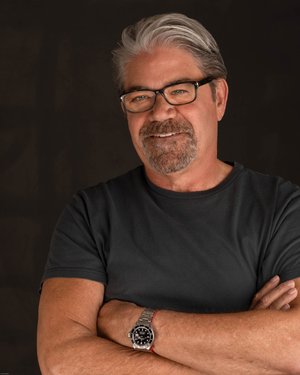
An Evening with Author Gary Rose In conversation with Alexa Rose Bookstar Barnes & Noble, Studio City
BOOKSTORE HOST
Hi, everyone, welcome to Bookstar. Thank you so much for joining us tonight for this chat with Gary
Rose, author of Sushi Row. We're very happy to have you all here.
In case you don't already have a book, that's totally fine. We have plenty behind the counter at
the front of the store. So at the end of the event, if you'd like to have yours signed, please head
to the back and we'll help you out.
Let me give you a quick introduction to Gary Rose. He is, of course, the author and photographer
behind Sushi Row. He has spent decades in film and commercial production, and his photography has
taken him everywhere from Papua New Guinea to the Galápagos. But this book brought him right back
home, to the sushi restaurants of Ventura Boulevard.
Tonight, his daughter, Alexa, will interview him. Thank you so much for joining us.
ALEXA
All right, you want me to take it away, Dad?
GARY
Sure.
THE BOOK, AND THE ACCIDENT OF IT
ALEXA
Okay, let's start off. Do you want to tell us a little bit about why you wanted to make this book?
And do you love sushi?
GARY
like the crab that's still looking at you. But I made this book by accident. I started out wanting
to do a photographic journey into sushi, photographing it in a way it hadn't been done before. It
was called Eating Art. As I went along, I started meeting the chefs and the owners, and before I
knew it, the stories behind the restaurants and the history behind Sushi Row were far more
interesting than the photography I was doing. The photography was good. But the stories are
amazing, and the book turned out to be full of American dreamers. That's what it became about.
ALEXA
Love it, Gary. I think I got ahead of myself. What is Sushi Row?
GARY
I do. I like sushi. I'm not one of those adventurous sushi eaters who'll eat the stuff on Asanebo's
plates,
Sushi Row doesn't officially exist. I've been trying for the last three years to get the city to
actually put up signs. It's this historic stretch, three miles of Ventura Boulevard, that started
with Nozawa, Asanebo, Taro, and Katsuya. They were really the first sushi chefs introducing America
to sushi, mainly to film industry people and musicians who were willing to take a chance and eat
raw fish, even though their parents were sure they'd end up in the hospital. But the sushi thing
caught on. It's an area that's been written about a ton. People talk about Sushi Row, but there are
still no signs.
Taro opened in 1979. Downtown Los Angeles, in Little Tokyo, was really the first introduction to
sushi, not in bars, but in restaurants. And when Taro opened, it was like the Academy Awards,
filled with every actor you could imagine, people who wanted to learn how to use chopsticks and
roll the dice on eating raw fish.
PATIENCE, AND A FAVORITE CHAPTER
ALEXA
Love it, Gary. All right, can I just call you Dad? What's one thing you learned while working on
the book that surprised you the most?
GARY
Good question. I mean, patience was a big one. It took a long time to get these restaurants to
understand that I was actually making a book, and that I wasn't trying to finagle them into
spending money somehow. They were all incredibly suspicious. In a lot of the restaurants the owners
aren't around, so you're very reliant on managers. I never thought some of them would take a year
before I got permission. I filmed in each restaurant using one specific set, to keep the playing
field level so everybody's photography would be the same. They were responsible for plating the
food and choosing what it was.
ALEXA
What's your favorite chapter, or the most rewarding one to write?
GARY
I had a great time at Asanebo. Anybody who knows Chef Tetsuya knows he's a character. I think he
actually speaks a lot more English than he lets on. He says he only speaks “sushi English,” and
claims he has no idea who any of the celebrities or musicians are, which is sort of funny.
His story is very unique. Not many people know he was Nobu's partner at a restaurant called Oshou.
The two of them left together and opened Matsuhisa, and Tetsuya was responsible for the menu. So
when he went off to open his own place, Asanebo, it had actually started life as a karaoke bar.
Another funny thing, I asked him what Asanebo means. We'd been talking about the karaoke bar, and
him and his brother drinking there into the early morning, and I said, “Oh my God, Asanebo means
hangover.” And he said, “No, no, no, no, no. It just means sleeping in late, in Japanese.”
REMEMBERING CHEF KATSUYA
ALEXA
Amazing. Okay, we're talking about chefs; I want to ask you about Chef Katsuya, who recently passed
away. I know he wrote the foreword to the book, so I wanted to ask how your experience was working
with him. And you should tell everyone about spicy tuna and crispy rice, because that was one of
the most interesting parts of the book.
GARY
He's credited with it, even though he'll tell you he didn't invent it, he just made it better.
Spicy tuna and crispy rice came from an idea he had: the biggest condiment in America is butter,
and the biggest condiment in Japan is soy sauce. So when he mixed the two together, and gently
pan-fried the rice instead of deep-frying it, it became something different, easier to eat, not
chewy.
The reason he came up with it was that a guy used to come into the restaurant every week with his
girlfriend, or maybe his wife, and she never ate any sushi; she'd just sit there while he ate for
an hour.
ALEXA
Like your wife.
GARY
Yeah, like my wife. Very similar. So one day Katsuya gave her this new rice concoction, and she
liked it. The next week he added the spicy tuna, and for extra measure, so she wouldn't taste
anything that resembled fish, he put jalapeño on top. And that was it. Other people in the
restaurant said, “I want that too.” That's how it came about. A version of the dish apparently
existed before, but he made it something special. We honor him tonight.
ALEXA
Yeah, it's really sad that he passed away. He was such an interesting guy; not only did he come to
this country with nothing and work his way up, but he…
GARY
He was a complete and total perfectionist. When we were doing the photo session, we went into the
restaurant between lunch and dinner, and the first thing he did was reach into the rice, and this
expression came over his face. He said, “Who made this rice?” and started in on the staff. They had
to take the whole batch away and make new rice because it was too moist; there was too much water
in it.
Some of that perfectionism was part of why his partnership with Sam Nazarian eventually fell apart.
They'd put restaurants in Dubai, Las Vegas, and elsewhere. Chef Katsuya got upset that they were
cutting corners and doing things cheaper, and that wasn't what he wanted his name on. So they
parted ways.
ALEXA
Amazing. Okay, I think we should take a break and get a question from the audience.
QUESTIONS FROM THE AUDIENCE
AUDIENCE MEMBER (STEVE)
What was Gary's first piece of sushi?
GARY
I think, like a lot of people, it was a California roll. And that's another funny thing about
Asanebo. When it was still the karaoke restaurant, the landlord wouldn't let them serve sushi, so
Tetsuya and his brother decided they'd just do sashimi. I asked him how that went, and he said,
“Horrible.” Everybody wanted California rolls. So yeah, the first thing I ever ate was a California
roll, well before I put a real piece of sushi in my mouth.
ALEXA
What was different? I mean, you go into a sushi restaurant for the first time, you don't even know
how to use chopsticks.
GARY
Right, so you're fumbling with those, and you start with something simple because you want to be
adventurous, but not too adventurous. One of the things I wrote in the book is that the people who
really enjoy sushi tend to be artistic, worldly people, people who read and want to try new things.
It's a bit of a raw fish cult, in the best sense, and you find that in sushi restaurants. So yeah,
you start slow, and over the years you get more and more adventurous.
ALEXA
I still don't like the orange stuff.
GARY
The sea urchin? People either love it or they don't. There's no in-between.
As for Taro, the original ownership group was around seven people from the entertainment business
and a couple of lawyers, and over the years that group narrowed down to a final three. What's
remarkable is that the restaurant is still in its original state. They've never changed or painted
over the tree murals on the walls. It's all still very original. Back then, sushi was becoming
novel in a few other pockets of the city too. The very first sushi bar had been downtown, in Little
Tokyo, before that it had just been restaurants serving Japanese food generally. Then somebody with
money and no idea what to do with it said, ·Let's open a sushi restaurant,· and it was supposed to
be crazy, cool, and hip.
Apparently the parking lot was full of Lincolns and Cadillacs and Rolls-Royces. It was quite a
scenein the seventies.
ALEXA
Getting the chefs on board for the photography was very difficult at first, wasn't it?
GARY
Very. So to sidebar a bit: I had a set built, a three-wall miniature set, and had it painted at an
auto body shop in black lacquer because I wanted the sushi to reflect. That created a lighting
nightmare, so I ended up putting a big light behind the set and lighting all the sushi with
mirrors. That let me catch things like roe or gold flake and make them pop. Everything was shot at
very high resolution, very high depth of field, a lot of light, so nothing was ever soft or out of
focus. Once the chefs saw those pictures, they came around. But the very first ones were hard. It
took some of the restaurants two years to say yes, and I was relentless. People who know me know
I'm a bit of a bulldog. I was there every two weeks. I had people throw me out, scream at me, yell
at me. I remember Charla telling me, “That's not going to happen.” I said, “Yeah, they will.
They'll come around.”
One time I had to send Charla into Sushi Dan on my behalf, because the owner hated me so much that
the second she saw my face, she started screaming. I didn't even get a word in. But eventually they
all came around. I stopped in just yesterday, and they told me he's a wonderful man now. It's like
the book has slowly saturated Studio City. I think people have gone into these restaurants and
mentioned the book to the owners. Even Chef Tetsu at Asanebo, since I didn't want to play
favorites, I organized the chapters east to west, which made him restaurant number seventeen. He
was not happy about that. He kept asking, “Why am I seventeen?” I said, “It's east to west.” He
said, “I know, but I still shouldn't be seventeen.” So the whole time, it was “seventeen,
seventeen…” But that's how I tried to keep it neutral.
One restaurant closed during the project, but it's still in the book. He's
actually on the cover. His name is Leo Akira, and his restaurant was called Akira. Someone drove a
car into it. His funding was from Japan, and rebuilding just wasn't in the cards; it was too crazy
an American thing to explain: a drunk driver with a dog and an ankle monitor plowed straight into
the restaurant and smashed it to pieces.
There was also a place called Ahi, on Coldwater and Ventura. That chef wasn't especially friendly,
and he's not in the book. He kept telling me he was going to close. One phenomenon I find genuinely
interesting is that when a sushi restaurant closes here, another sushi restaurant almost always
opens in its place. Kazu had been open thirty-five years and specialized in omakase. The chef
screamed and yelled at me the first time I walked in. He was getting ready to close and move back
to Japan to run a six-table restaurant out of his house. I walked in without a camera, and it was
the best photograph I never took, this seventy-year-old Japanese man perched on a stool in Crocs
and white tube socks, one Croc off, massaging his foot. I would have done anything for that shot,
but he wouldn't let me photograph him or his wife, and he threw me out because he was closing for
good.
So I went back on a Saturday night. The restaurant was empty. I said, “all right, I'm going to eat
something.” He said, “Get out.” I said, “I'm hungry.” He said, “omakase.” I asked how much that
was. “Two hundred fifty,” he said. I told him no, I'd just order some rolls. I sat there ordering
for two hours and heard his whole story. It was touching. Within three weeks, Sushi Bar Tetsuya was
moving into that same space; it's a phenomenal restaurant today. I actually asked him in the
interview, “Are you crazy? Opening a sushi restaurant with nineteen competitors, in a space where a
sushi restaurant just went out of business, that's not good business.” And he said, “My sushi is
better.” Now that restaurant is full of people; it's kind of crazy, but it's a real phenomenon.
There are ten restaurants on Sushi Row that have changed names over the years and simply become the
next sushi restaurant.
Sugarfish is in the book out of respect for what Nozawa did, and for how he tried to explain
omakase to Americans in the first place. For people who'd never encountered it, the whole idea was
strange: “Wait, you're going to tell me what I eat? I'm the one paying the bill.” He became known
as the “Sushi Nazi,” famous for things like throwing Gwyneth Paltrow out for ordering a California
roll. There are so many stories about him. It's really become a chain now. They own Sugarfish, HiHo
Burger, and an Italian restaurant. Every time I tried to get an interview with Tommy, his son, or
with Mrs. Nozawa or Chef Nozawa himself, their publicist said no, flatly, from day one. I said,
“I'm talking to Tetsuya at Asanebo, I'm talking to Chef Katsuya.” She said, “No, you can't talk to
them.” So I ended up writing that chapter from researched, published information. I had to include
him; he was a hugely important part of Sushi Row, especially in the early days.
Sushi Row actually predates Matsuhisa by about ten years. People don't often think about that. In
1979, the restaurants people usually picture didn't exist yet. Chef Katsuya later opened Koi, which
was very popular, and Matsuhisa is considered one of the premier Japanese restaurants in the world.
I think it all started here because of the film studios. We were kitty-corner to Disney, Universal,
and Warner Brothers, and all the agents were over in Beverly Hills. In the 1970s, New Hollywood
exploded; we had Jaws and Apocalypse Now, and so many great films; a run like that has never really
happened again. Everyone had to get back to work on soundstages or sets, so they'd meet their
agents in the middle. Every restaurant I spoke to said their crowd was full of musicians, agents,
actors; someone would rattle off ten celebrities and add, “and that was just a Tuesday afternoon.”
That's who filled these restaurants and wanted to eat sushi first. It's like advertising: why are
celebrities used in ads? Because they're aspirational. Other people see that and think, “I want to
be like that.”
ALEXA
While we're on the topic of the film industry, I want to ask you, Mr. Film Boy, you're a filmmaker
and photographer, not an author, until now. What was the hardest part of writing your first book?
GARY
Writing is difficult because you're siloed. I think everyone who's written a book knows that
feeling, especially after a while. This book took three years, and you're working on it with no one
to talk to. That changed at the end. Alexa edited the book, and that was remarkable. But that's the
hard part. As a photographer, you take a picture and get immediate feedback. You like it or you
don't. I think every photographer looks through their images and thinks, “this one's bad, this
one's bad, this one's bad… oh, that one's good.” But with writing, for me it was more like, “I hope
people don't hate this.” I tried to keep it in my own voice, casual and fun, because I didn't want
it to feel heavy or judgy.
ALEXA
It's a great read. And once we got rid of all your little dyslexic moments…
GARY
Yes, I am dyslexic, which makes writing even harder. We worked together to get through that.
ALEXA
Yes, we did. Does anyone else have a question?
FAVORITES, AND THE HARDEST QUESTION
ALEXA
So, everyone wants to know: what's your favorite restaurant on Sushi Row?
GARY
Knew that was coming. That's the ten-million-dollar question. I've been asked it a hundred and
fifty times, and I answer it the same way every time. These restaurants are all different. They
each have a different vibe, and it depends on your headspace, on what you're in the mood for. Taro
is casual, fun, and family-oriented. Asanebo is a bit more upscale. Sushi Bar Tetsuya is fantastic.
Tomoki is fantastic. It's really all about the environment. Leona's is like a nightclub; the guy
behind the bar, Jose, knows every tequila on the planet, so you can have sushi and tequila, nothing
better, right? It's all about the vibe. And I swear, I do not have a favorite restaurant. I know
that's not really an answer, but it's the best I've got.
Do you want to spend money, or not? You're sitting in the sushi capital of the world; there are
more sushi restaurants in these three miles than anywhere else outside of Japan. If you just want
some solid sushi, you could order Katsuya Delivery; it's pretty good. If you want something else,
there's Shiki, a tucked-away little place with a real family feel. There's also Sushi Stop, where
you can get a poke bowl for ten dollars. They're all different, and honestly, it's genuinely hard
to answer the question.
ALEXA
I'll say, since I can be a little biased, Katsuya was the first place Dad ever took my brother and
me. We'd never had sushi before. He was writing this book, and now we're both sushi lovers. Great
experience, ten out of ten.
I'll say, as someone who doesn't live out here, it's a classic Valley staple; Katsuya is always a
winner, always good. But there are others too. Tetsuya's is amazing if you're looking for a fancy
date-night sushi dinner; it's fantastic, and he's an incredible chef. He used to cook for the
Dodgers. He's covered in tattoos; he's the coolest-looking guy you've ever seen.
ALEXA
Do we have any other questions from the crowd?
AUDIENCE MEMBER
What was the most surprising story, either about how a restaurant came to be, or about one of the
owners, the most surprising thing you learned?
GARY
One of the most surprising, honestly kind of shocking, stories was that Taro is owned by the man
who was the parking valet on the night it opened. That's a wild story; he must have parked a lot of
cars to end up owning the place. The original owners really liked him, and for twenty years they
told him, “if you ever want to sell the restaurant, please come to us first.” By the time his
parking career was done, he had a whole parking empire; he was parking cars at nearly every
restaurant on Ventura Boulevard, and he eventually parlayed that into a security company as well.
He was an immigrant, sixteen years old, came from Iran with nothing, and today he owns one of the
most historic restaurants on the whole road.
S
GARY
I was genuinely worried about getting this into its final form. I'd never done a book before, so it
was one of those things where you're just hoping it comes out right. I made some mistakes. I'd
never done it before; I didn't have a mentor, I just went for it. That little code on the back, the
ISBN, don't buy the cheap one. There's a version for thirty-five dollars and one for a hundred and
fifty; buy the hundred-and-fifty-dollar one. It's a whole story, but I learned the hard way. If
you're a publisher, you probably already know that.
No, I self-published the book. I started a company called Sushi Row Publishing. Publishers honestly
didn't understand the book; some thought it should have recipes in it. I heard a lot of different
reactions. I talked to plenty of very well-known coffee table book editors, and the response was
usually some version of, “yeah, but every neighborhood has sushi restaurants.” I'd say, “yeah, but
nowhere else has this many.” They weren't always convinced people would go for it. But readers on
the East Coast have bought the book and enjoyed it too, because it's about a phenomenon that
happened right here, one they'd never heard about before. I'm still looking for a publisher,
because I'm only doing this once, and once these copies are gone, they're gone. They're almost sold
out, so get one while you can.
AUDIENCE MEMBER (STEVE CAPLAN)
What did all this actually cost you, in terms of the food alone?
GARY
Honestly, I don't know what it all added up to. I was fortunate enough to get to eat everything I
photographed. It's a hard job, but somebody's got to eat it. I really did eat everything. In fact,
there were things I still couldn't tell you what they were. At Asanebo, there was this one dish
with a little crab standing straight up, looking right at me. I said, “that's garnish, right? You
don't actually eat that.” He said, “yeah, you eat it.” I said, “maybe you eat it.” He said, “no,
don't be a wimp, just eat it, it's like a chip.” I said, “but it's a whole crab, looking at me.”
Now there are three chefs standing there watching, so I ate it. It did not taste like a chip. It
tasted like eating a crab shell.
It was very hard physically too. My Tesla basically became a grip truck, packed with C-stands,
lighting boxes, softboxes, all kinds of gear. At one point I actually considered extending the
project all the way from Sherman Oaks to Woodland Hills, some people argue that's the real
corridor, others insist Sushi Row is the true core of where it all started. It's debatable, there's
no judge and jury on it. I did think, for a while, “it would be cool to cover every single
restaurant,” and then I realized that book would run seven hundred pages and weigh twenty-five
pounds. I changed my mind fast.
AUDIENCE MEMBER
Could this ever be a reality show?
GARY
I don't know that it could be a reality show, honestly; these guys aren't exactly entertainers, and
they take what they do very seriously. I did once mention it to a producer friend, told him, “hey,
I'm working on this thing,” and how it had turned into this American dream story, the most sushi
restaurants anywhere in the world, the place where sushi in America really started. I genuinely
think there's a documentary in it. Nothing came of that conversation at the time, but I've since
talked to someone else who saw the book and said, “I'm going to bring this to my team, this could
be a really interesting documentary.” I do think it could work as a documentary, but it would
probably need to expand to cover how sushi developed across all of Los Angeles because L.A. was
actually the first place in the country to eat sushi. I believe they even mentioned Taro when I was
interviewing them; they showed me the old clip from Entourage.
AUDIENCE MEMBER
Last question, what about Sawtelle? It has such a large Japanese population.
GARY
It would be pretty odd for a neighborhood like that not to have its own cluster of sushi
restaurants, and Sawtelle is actually where Sushi Stop got its start. It's Japanese-owned, the
company itself is based in Japan, and they send a small team over to run things here. I remember
pitching the whole project to the man running it, Masumi, going as fast as I could, telling him it
was going to be great, that I'd get the chef and the whole restaurant involved. He just sort of
went along with it, and it wasn't until we actually started shooting that I realized he barely
spoke any English at all, so I'm honestly not sure how much of it he understood going in. It's been
since June 1, and I still haven't managed to get him a copy of the finished book; I'm not even sure where he is these days. But Sawtelle is, without
question, a hugely significant Japanese neighborhood.
BOOKSTORE HOST
Well, thank you so much, Gary. If anyone has more questions while you get your book signed, feel
free to ask; he'll definitely answer it. Thank you.
GARY
I just want to say, obviously there are a lot of people here tonight, and I want to thank everyone
who made the trip out to support me on this project. I know it's a lot of traffic and a lot of
hassle, and I really appreciate it. Thank you.
Oh, and did everybody get a raffle ticket? We're raffling off a copy of the book tonight.
Two, two, six, eight, seven, two, dash, zero, two, eight. Good job, that's his book.
GARY
There were really two kinds of chefs on Sushi Row. There was Nozawa, who was all about
authenticity. He was trying to make Americans understand real Japanese sushi, exactly as it's done
in Japan. And then there were chefs like Katsuya, who wanted to adapt sushi for the American
palate. When you go to Japan and eat sushi there, it's quite different, simpler, larger cuts of
fish. That's just how it's done there. There's no “oh my God roll,” nothing like that. I wanted a
sexy roll, and a Studio City roll, and that's exactly what we got.
BOOKSTORE HOST
Thank you so much for coming, everybody. If you don't have a book yet, we have them at the front,
behind the counter. Feel free to head back there, buy one, and come on back to have it signed.